|
On the eve of Passover a new star appeared in the land of Arsareth, brighter than any star in the heavens. Hallel the chief governor of the Federation of Tribes and everyone in Arsareth knew what it meant; the Messiah, the King of Israel, had been born in far away Judea. Before their conquest by Assyria, Isaiah and the prophets had long foretold of the coming of the Son of God.
Hallel sent a proclamation throughout the land announcing the birth of their newborn King and called for a conference of his advisors, the tribal governors, Ehud the prophet, and Hadar the chief priest, to convene at the conclusion of Passover.
In accordance to the Law of Moses, temples throughout the land and the Levites were inundated performing sacrifices in similitude of the sacrifice that the Son of God would make for them. As the people rejoiced at the news, the feasting and celebrating lasted eight days in commemoration of the deliverance of their ancient ancestors from Egypt coupled with their escape from Assyria at the time it was conquered by Babylon.
In his opening address Governor Hallel declared, “The time of our redemption is at hand. We have been exiles in this bounteous land now for six hundred years. We can only assume our brethren Judah and Benjamin of the Kingdom of Judah are still intact, although the reach of Babylon has most likely extended to them.
“I propose that an expedition of ten men, one from each tribe, be commissioned with a two-fold mission: one to represent us before our King with gifts, and second to determine if the state of affairs in our homeland is such that we can return as has been prophesied.
“These men are to be wise men of sound understanding. They must be strong men capable of such an arduous journey and defending themselves. Above all, they must men of faith, having a the spirit of prophesy and revelation.
“Have them report here one month hence to begin their training that I anticipate to take six weeks. The journey itself I expect to take a year and half. It took our ancestors that long to come from Assyria but it is farther to Judea. Unburdened by women and children their travels will be swift. By the time they arrive in Judea the King will be a small child.
“Now, the subject is open for discussion.”
The council discussed the governor’s proposal to work out the preliminary details and adjourned in agreement and a plan in place.
* * * * *
Over the next four weeks the ten men assembled to begin their preparations. They were:
Miron from Reuben; Oz from Simeon; Saar from Dan; Aharon from Naphtali; Haral from Gad; Ira from Asher; Ammon from Issachar; Gavriel form Zebulun, Dori from Manasseh; and Melech from Ephraim. Melech was chosen to be their leader, with Dori on his right hand and Ammon on his Left.
Their training included the languages they would encounter, the geography of the land they would cross, the art of defense if confronted, horsemanship, and other subjects of importance. Each man had his duties: two were to scout ahead to find the best route. Another was in charge of the horses. One was to keep a detailed record of the journey. They were to take turns standing guard over the camp by night looking out for predators and marauders.
While in training they were outfitted with strong horses: to ride, carry their supplies, their replacements, armor, weapons, and provisions; also ample amounts of gold and silver from the treasury and precious spices and ointments, all to be used for barter and gifts for the Christ Child.
On the eve of their departure a feast was held in their honor at the governor’s palace. A sacrifice of a young bullock was offered, the chief priest anointed each with the blood of the bullock on their foreheads, blessing them with protection and discernment on their mission. While dining on the bullock Ehud the prophet prophesied that after the Savior rose from the dead he would personally minister to their nation. Hallel the chief governor charged the company not to divulge their identity or where they came from accept to the virgin mother and her husband.
The next morning the company rode out of the city to the cheering of the throngs gathered to see them off.
* * * * *
The company made good time traveling south trough the fertile plain with its villages, towns, and cities, golden wheat fields, vineyards and orchards laden with fruit until coming to the Caucasus Mountains. Ascending the northern slopes they encountered grasslands and forests of oak, maple, and ash at the lower elevations; giving way to birch and pine. Water and grass was plentiful for their horses and wild game for the company. Once above the tree line the landscape was barren and rocky with snow capped peaks towering above: the highest at over 16,500 feet in elevation, the pass through the mountains at 7,800 feet.
While traversing the pass, one of the pack horses lost its footing on loose rock and fell into a ravine. The animal could not be saved but the cargo it carried was salvaged and redistributed among the other pack horses. The most difficult part was going through the pass hoping to get through before winter set it. It was hard to imagine their forefathers traversing the pass with their wives and children, flocks and what they could bring with them.
A mixed forest of spruce, fir and beech covered the south slopes coming down into the valley where they camped during the harshest part of the winter. Setting out again when the snow began to melt there were more mountains to traverse, although not as rugged, and there was plenty of feed, water, and game.
In late spring they reached the headwaters of the Euphrates and followed the river to the place where God had stopped the flow to let their ancestors cross. Crossing with high water because of the spring runoff proved treacherous. Another horse and its cargo was lost and Aharon nearly drowned.
Setting out into the desert they had to defend themselves against marauders. The roving bands that infested the foothills mostly stayed clear of the heavily armed company, although once they had to fight off a band that outnumbered them three to one. The fight left twelve bandits dead, the rest retreated to their hideout. Miron received severe wounds that required treatment.
When they reached the fortress of Raḥabah they traded their pack horses for camels and acquired fresh provisions before heading south into the desert at the one-year mark in their journey.
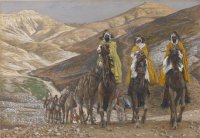
By late fall they came to the major east-west trade route leading to Jerusalem and stopped again to rest and resupply from the merchant caravans. From that time they traveled west and in the spring they arrived at Jerusalem from the east, their arrival coinciding with Passover.
* * * * *
Unfamiliar with the political climate, they proceeded with caution. A lot had changed in the 600 years since their ancestors had been carried away captive into Assyria. When they had to pass through a checkpoint on the road from Jericho manned by Roman solders it quickly became obvious that Judea was occupied by a foreign power. They were questioned about who they where, were they came from, and their purpose. Spokesman Melech explained that they had come from a far country on a trade mission, a common story that the Romans believed. After extracting a tariff that they paid in silver the Romans let them pass.
Just outside the city they set up camp in the Cedron Valley at the foot of the Mount of Olives. After getting settled, Melech, Dori, and Ammon entered the city through the Lion’s Gate, leaving the rest to tend the animals and guard the treasures they brought. They found the language similar enough that they were able to communicate, their objective being to learn their way around and determine what had taken place since the departure of the Ten Tribes.
Their presence and inquiries drew the attention of a ranking member of King Herod’s court, resulting in a meeting with the King. Not understanding the disposition of the king they divulged that they came seeking the newborn King of Israel, explaining that they had seen the star signifying His birth. Herod’s interest heightened and he inquired of his priests as to where it was prophesied that the Messiah would be born. They answered, “In Bethlehem.”
Herod sent them on their way with instructions to return and inform him where they found the Christ Child that he may also pay homage. Melech, Dori, and Ammon returned to camp and told the rest what they had learned. Melech added, “I don’t trust the king. I sense his intentions are selfish and evil.”
The next day the company broke camp and entered the city. After receiving directions to Bethlehem, the small caravan made their way through the city bustling with Passover activities and onto the road to Bethlehem a few miles south of Jerusalem. Arriving in late afternoon they again set up camp. Toward evening the star they had been following rose over the City of David. Being guided by the star and the Spirit of God, they found the house and knocked on the door.
* * * * *
A middle-aged man opened the door alarmed to see several well dressed men standing outside. “May I help you?” he nervously asked.
“We seek the Christ Child.” Melech said. “We have come a long way to worship him.” Just inside the door he saw children playing on the floor. His eyes fell on a two-year-old toddler and his bosom burned with in him. His mother picked him up and came to the door. “It’s alright Uncle Avram,” Mary said. “Please come in,” she invited. “This is Jesus, whom you seek,” she said referring to the child in her arms.
The ten men filed into the house, some bearing chests, and closed the door behind them. “I am Melech of the tribe of Ephriam,” he introduced. Each man introduced himself in turn.
Melech continued, “Two years ago the star of the sign of His birth appeared in our land far away. We were sent to represent the ten tribes, bringing gifts.” Haral and Ira opened a chest full of gold and silver. “This,” Melech said, “should provide for his needs until he is grown.”
“We can’t accept this!” Joseph protested. “God has entrusted me to provide for him.”
“You must accept our sacrifice,” Melech countered. “Even if you give it to the poor.”
“We accept,” Mary agreed.
“There’s more,” Melech added.
Miron and Oz opened a second chest full of precious spices and ointments, including frankincense and myrrh.
Melech opened a cask of oil, poured some onto the tip of his forefinger and daubed it on to child’s forehead. He declared, “In the name of Ehud, the prophet God among the ten tribes of Israel, I anoint you to be our King. It has been prophesied that when your mission here is complete, you shall come among us and and establish your higher law. I hope I’m alive to witness it.”
Melech continued, “What I tell you now must not be known to the world.” He explained the history of his people and where they were. “If it were to be known, our land would be overrun by those who seek conquest.”
After listening to their story, Uncle Avram invited them to stay the night and tell them more.
“Nay. We durst not,” Melech said. “I fear we may have been followed and we do not want to put your family and particularly our young King in danger. We have completed our mission and will take our leave.”
Leaving their treasures, they departed into night. The star that had guided them had mysteriously vanished.
* * * * *
Returning to camp something was amiss. A campfire burned silhouetting a figure. Cautions, they looked around to see if there were more than one. Ammon drew his sword.
“You there!” Melech called. “Identify yourself.”
The figure stood, turned around and walked toward them.”
“Fear not, brethren. Peace be unto you. I am Gabriel, an angel sent from God.”
“You don’t look like an angel,” Melech challenged. “Prove it!”
“Alright,” Gabriel agreed. “You are Melech of the Tribe of Ephraim. All of you are men of lost Israel come to seek the Messiah.” For added proof he let his glory shine, nearly blinding them in the darkness.
“Now do you believe me? I didn’t want to give you away by so I contained the light with in me.”
Gabriel resumed his previous appearance and Melech said, “We believe you,” and extended his hand.
“Touch me not,” Gabriel forbade, “For I am a spirit, not yet reunited with my body. I have come to deliver a message. Return not to Jerusalem for Herod seeks the life of the Christ Child and your lives are in danger. Depart hence out of this land by some other way. Go quickly and tarry not.”
“What of the Messiah?” Ammon asked.
“He is safe. I have warned Joseph and even as we speak, he, Mary, and Jesus are fleeing into Egypt where they will be safe.”
His message delivered, Gabriel vanished from sight.
“Okay you heard him,” Melech said. “Let's break camp and head out.”
“Which way?” Miron asked.
“North,” Melech determined. “We’ll skirt around the west side of the city and will be well beyond by morning.”
The ten men wasted no time breaking camp and packing the animals. Dowsing the fire they mounted up and rode out, a waning moon lighting the way. At midday they stopped to rest before continuing on the next day.
* * * * *
Furious that the strangers did not return to report where they found the King he feared, Herod went into a jealous rage and ordered the slaughter of every male child in Bethlehem and the region round about. Melech and his company never knew of the massacre.
The company stopped in Samaria in what had been the land apportioned to the tribe of Ephriam to resupply. With less to take back than they came with, they sold the camels and used the money to purchase supplies needed for the return trip.
They were surprised to learn that the Samaritans were descendants of Israelites who had avoided capture and the colonists the king of Assyria had settled in the region. Melech determined that the people back home would want to know of what became of their homeland so without disclosing their identity they lingered in the area that had been the Kingdom of Israel.
From there they went to Damascus and made their way across the Syrian Desert to the Euphrates River, where they retraced their route back to the land of Arsareth, arriving just short of three years.
Hallel had been succeeded by Eliezer as chief governor. They made their report to the governor and Ehud the prophet. A proclamation was sent throughout the land detailing their travels, their encounter with the Messiah, and what they had learned of their homeland. Discharged from their service lauded as heroes, each returned to their homes, families, and livelihoods.
The years passed and thirty years later all but two still lived. Then one day the mountains they had traversed trembled and the sky darkened—the sign of the death of the Son of God. On the third day the darkness was pierced by a pinpoint of light, growing brighter as it descended, dispelling the darkness. A voice from heaven declared, “This is my Only Begotten Son in whom I am well pleased.”
Within the light was the Jesus of Nazareth, the child Melech had been sent to find. As He stood in the midst of the multitude gathered in the City of Ephriam he declared, “Behold, I Am Jesus Christ who was crucified for the sins of the world. Come unto me and feel the prints of the nails in my hands and feet that you may know that I Am the God of Israel.”
The people went forth; when Melech knelt at His feet, Jesus said, “Arise Melech. Blessed are you and your brethren who testified of me to this people.”
During the time the Savior spent with them He traveled throughout the land teaching the gospel He had taught in Judea, established the higher law superseding the law of Moses and formed His church before ascending into heaven. Melech and the other seven lived to see Him before their deaths.
As for the nation, it thrived for nearly two hundred year until pride and apostasy filled the hearts of that generation. Just like their ancient ancestors they were ripe for destruction and the land unknown to the rest of the world was conquered by foreign invaders. Having been assimilated into the new culture, they lost their identity and were scattered and lost from history, with the promise that their descendants would be gathered in the latter days.
|